
Description
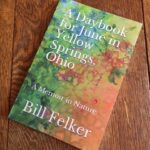
The DAYBOOK FOR JULY IN YELLOW SPRINGS offers a day-by-day description of the progress of common events in nature during the month. Covering most years between 1981 and 2023, it offers the most complete portrait currently available of this period of the year in southwestern Ohio.
The Daybook Format
Here are no stories told you of what is to be seen at the
other end of the world, but of things at home, in your own Native
Countrey, at your own doors, easily examinable with little travel,
less cost, and very little hazard. This book doth not shew you a
Telescope, but a Mirror, it goes not about to put a delightful cheat
upon you, with objects at a great distance, but shews you
yourselves.
Joshua Childrey, 1660
The Daybook Format
The format of my notes in this daybook owes more than a
little to the almanacs I wrote for the Yellow Springs News between
1984 and 2021. The use of quotations, daily statistics, the weather
outlooks, the seasonal calendar, and the daybook journal were and
still are part of my regular routine of collecting and organizing
impressions about the place in which I live.
Setting: The principal habitat described here is that of
Glen Helen, a preserve of woods and glades that lies on the eastern
border of the village of Yellow Springs in southwestern Ohio. At
its northern edge, the Glen joins with John Bryan State Park to
form a corridor about ten miles long and half a mile wide along the
Little Miami River. The north section of the Glen Helen /John
Bryan complex is hilly and heavily wooded and is the best location1Bill Felker
for spring wildflowers. The southern portion, “South Glen” as it is
usually called, is a combination of open fields, wetlands, and
wooded flatlands. Here I found many flowers and grasses of
summer and fall. Together, the two Glens and John Bryan Park
provide a remarkable cross section of the fauna and flora of the
eastern United States.
Other habitats in the daybook journal include my yard
with its several small gardens; the village of Yellow Springs itself,
a town of about 4,000 at the far eastern border of the Dayton
suburbs; the Caesar Creek Reservoir twenty miles south of Yellow
Springs. My trips away from that environment were principally
northeast to Chicago, Madison, Wisconsin and northern
Minnesota, east to Washington and New York, southeast to the
Carolinas and Florida, southwest to Arkansas, Louisiana and
Texas, and occasionally through the Southwest to California and
the Northwest, two excursions to Belize in Central America,
several to Italy.
Quotations: The passages from ancient and modern
writers (and sometimes from my alter egos) which accompany
each day’s notations are lessons from my readings, as well as from
distant seminary and university training, here put to work in
service of the reconstruction of my sense of time and space. They
are a collection of reminders, hopes, and promises for me that I
find implicit in the seasons. They have become a kind of a
cosmological scrapbook for me and the philosophical underpinning
of this narrative.
Astronomical Data: The Daybook includes approximate
dates for astronomical events, such as star positions, meteor
showers, solstice, equinox, perihelion (the Sun’s position closest to
Earth), and aphelion (the Sun’s position farthest from Earth).
I have included the sunrise and sunset for Yellow Springs
as a general guide to the progression of the year in this location,
but those statistics also reflect trends that are world wide, if more
rapid in some places and slower in others.
Even though the day’s length is almost never exactly the
same from one town to the next, a minute gained or lost in Yellow
Springs is often a minute lost or gained elsewhere, and the Yellow
2A Daybook for July
Springs numbers can be used as a simple way of watching the
lengthening or shortening of the days, and, therefore, of watching
the turn of the planet. For those who wish to keep track of the Sun
themselves in their own location, abundant sources are now
available for this information in local and national media.
Average Temperatures: Average temperatures in
Yellow Springs are also part of each day’s entry. Since the rise and
fall of temperatures in other parts of the North America, even
though they may start from colder or warmer readings, keep pace
with the temperatures here, the highs and lows in Yellow Springs
are, like solar statistics, helpful indicators of the steady progress of
the year throughout most of the states along the 40th Parallel
(except in the mountains). The daybook journal entries can be
cross-referenced with the list of monthly average temperatures
between 1981 and 2017 in order to compare the daily inventories
with the month’s weather in a given year.
Weather: My daily, weekly and monthly weather
summaries have been distilled from over thirty years of
observations. They are descriptions of the local weather history I
have kept in order to track the gradual change in temperature,
precipitation and cloud cover through the year. I have also used
them in order to try to identify particular characteristics of each
day. They are not meant to be predictions.
Although my interest in the Yellow Springs microclimate
at first seemed too narrow to be of use to those who lived outside
the area, I began to modify it to meet the needs of a number of
regional and national farm publications for which I started writing
in the mid 1980s. And so, while the summaries are based on my
records in southwestern Ohio, they can be and have been used,
with interpretation and interpolation, throughout the Lower
Midwest, the Middle Atlantic States and the East.
The Natural Calendar: In this section, I note the
progress of foliage and floral changes, farm and garden practices,
migration times for common birds and peak periods of insect
activity. Some of these notes are second hand; I’m a sky watcher,
but not an astronomer, and I rely on the government’s astronomical
3Bill Felker
data and a few other references for much of my information about
the stars and the sun. I am also a complete amateur at bird
watching, and most of the migration dates used in the seasonal
calendar come from published sources. And even though I keep
close track of the farm year, the percentages listed for planting and
harvesting are interpretations of averages supplied by the state’s
weekly crop reports.
At the beginning of each spring and summer month, I
have included a floating calendar of blooming dates which lists
approximate flowering times for many plants, shrubs and trees in
an average Ohio Valley season. The floating chronology describes
the relationship between events more than exact dates of these
occurrences.
Although the flora of the eastern and central United States
is hardly limited to the species mentioned here, the flowers listed
are common enough to provide easily recognized landmarks for
gauging the advance of the year. I found, for example, that a record
of my drives south during April complemented the floating
calendar and allowed me to see the approximate differences
between Yellow Springs and other locations. I also learned that
April in the Lower Midwest is more like March in the Southeast
and more like May in the Upper Midwest. The Natural Calendar
summaries, then, provide guidelines for moveable feasts that shift
not only according to fixed geographical regions but also
according to the weather in any particular year.
Daybook Entries: The journal entries in the daybook
section provide the raw material from which I wrote the Natural
Calendar digests. They offer a record that anyone with a few
guidebooks could make, and they include just a small number of
the natural markers that anyone might discover.
When I began to take notes about the world around me, I
found that there were few descriptions of actual events in nature
available for southwestern Ohio. There was no roadmap for the
course of the year. My daily observations, as narrow and
incomplete as they were, were especially significant to me since I
had found no other narrative of the days, no other depiction of
what was actually occurring around me. In time, the world came
into focus with each particle I named. I saw concretely that time
4A Daybook for July
and space were the sum of their parts.
As my notes for each day accumulated, I could see the
wide variation of events that occurred from year to year; at the
same time, I saw a unity in this syncopation from which I could
identify numerous sub-seasons and with which I could understand
better the kind of habitat in which I was living and, consequently,
myself.
When I paged through the journal entries for each day, I
was drawn back to the space in which they were made. I browsed
and imagined, returned to the journey.
Journal Essays: At the end of many of the daybook
entries, I have included brief essays from my almanac column in
the Yellow Springs News.
Companions: Many friends, acquaintances and family
members have contributed their observations to the daybook, and
their participation has taught me that my private seasons are also
community seasons, and that all of our experiences together help to
lay the foundation for a rich, local consciousness.
5
Only logged in customers who have purchased this product may leave a review.

Reviews
There are no reviews yet.